
RYAN D'EMIC

CTO · The RAM Group

More leverage. Less chaos.

I'm Ryan D'Emic. I help owners and leadership teams see the business as one system, find where it leaks, and fix it.

Your business, as a system

Diagram: a business drawn as eight connected parts. People, Process, Demand, Data, Technology, Execution, Money, and Decisions, with current flowing between them.

Ryan D'Emic
  • Seven figures in added annual gross profit, on the same clients at the same budgets, and the clients got better results.
  • A $15,000 a month quote, replaced by a spreadsheet and two scripts in twenty hours.
  • Fifty-three months of a department run on a spreadsheet, automated and replaced in two weeks.

Most businesses do not need more tools.
They need better systems.

The system

This is how I read a business.

  1. PeopleProcess

    Every business runs on people following a process. When the process lives in someone's head, you do not have a system. You have a dependency.

    Symptom: Work stalls whenever one person is out.

  2. DemandData

    Every lead you buy is worth exactly what the follow-up does with it. Doubling demand into a process that cannot keep pace just raises the cost of the ones you lose. The data is what tells you it is happening.

    Symptom: Leads are up and sales are flat.

  3. TechnologyExecution

    Tools do not fix systems. A good system makes ordinary tools look brilliant. A broken one makes expensive tools look useless.

    Symptom: Every new tool adds more work.

  4. MoneyDecisions

    Margin hides where nobody is looking: vendor contracts, unused software, reports nobody reads. When money data reaches decisions, leverage compounds.

    Symptom: Revenue grows and profit does not.

The work

Three systems we replaced while the business kept running.

I proposed, designed, or led each change, but none of them happened alone. Ownership backed the work, and strong teams helped test, adopt, and operate the systems. All three made the company money, and all three made the clients more successful.

01

Four marketing channels, restructured at once

I restructured how we deliver streaming TV, search, social ads, and vehicle ads. I wrote the plan and pitched it to the owners in the van we work out of, on the way to a dealer pitch. They approved it that day. Then we rebuilt them one at a time. Search came last, with a team I hired for it, and I split that rollout in two a month apart so no client had everything change at once. The hardest piece was inventory data, the vehicle feeds that keep every ad showing cars the dealer actually has. The fix on the table was hiring a developer to scrape dealer websites every day, six figures a year in salary alone.

Seven figures
Added annual gross profit
Same budgets
No client paid more for it
30 days
To replace a six-figure hire

What the clients got

Clients got the better end of it: search traffic that grew instead of sliding, and ads that stopped going dark whenever an inventory feed broke.

I did not hire the scraper. The same feeds were available straight from the source, free and more accurate. Working that out took a day. Getting every feed in place took about thirty.
02

Budget pacing that was most of somebody's job

You cannot set a monthly budget in Google Ads and walk away. Google spends it in the first two weeks and the campaign goes dark. So you are forced onto daily budgets, and Google can spend double any daily number you give it. The target moves every morning, for every campaign. We were doing that by hand, across hundreds of campaigns. It was most of one role. The quote to automate it was $15,000 a month. I built it in twenty working hours with a spreadsheet and two scripts.

$15,000 / mo
Quoted to automate it
20 hours
To build it instead
Every morning
Since November 2025

What it actually is

A shared pacing sheet, six scripts on Google Ads, and a parallel layer on Microsoft Ads.

The point is not the spreadsheet. It is the operating loop.

  1. MeasureDaily, 5am

    Actual month to date spend, every campaign.

  2. DecideThe sheet

    The daily budget that lands the month on plan.

  3. ActDaily, 6am

    Write it back. Respect anything on hold, and pause any campaign with no approved budget.

The guardrails

None of these pace anything. Each one assumes something will go wrong. A mistyped ID, a campaign nobody added, a budget nobody approved.

  • Overspend backstopHourly

    Compares each account's spend to its approved total. If it ever goes over, it pauses that account's campaigns and emails the team.

  • Coverage auditDaily

    Reads Google Ads and the sheet against each other, in both directions. Catches campaigns spending outside the system, and IDs that point at nothing.

  • Anomaly detectionWeekly

    Flags drops in conversion and traffic efficiency, spend with no conversions, and likely tracking failures.

  • Month-end reconciliationMonthly

    Pulls the month's final spend into the archive, so the month closes on platform data.

Measure, correct, and check every place the correction can fail. That is a feedback controller with independent guardrails, which is a strange thing to find running an ad account.

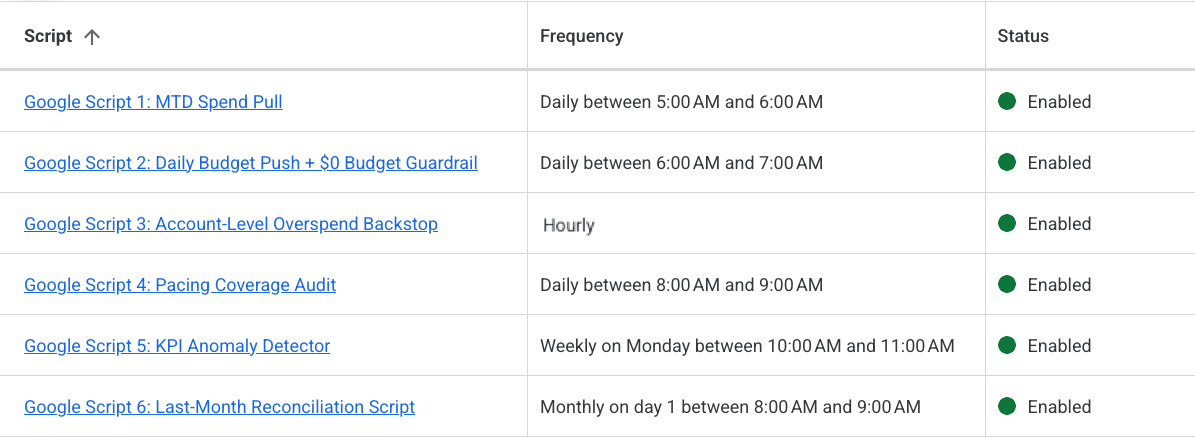
The six Google Ads scripts that run the pacing system, each listed with its schedule and all six showing as enabled: month to date spend pull daily at 5am, daily budget push and zero-budget guardrail at 6am, account-level overspend backstop hourly, pacing coverage audit daily at 8am, KPI anomaly detector weekly on Monday, and last-month reconciliation monthly on day one.
Six scripts, six schedules.
What the sheet tracks, per campaign
  • Monthly budget
  • Spend to date
  • Percent spent
  • Remaining budget
  • Days remaining
  • Today's daily budget
  • Projected end of month
  • Over or under
  • Flag
  • Ready or hold
  • Auto or manual
  • Platform

Hundreds of campaigns, every morning.

What the clients got

Their money lands where it was supposed to, spread evenly across the month. Campaigns are far less likely to go dark early or overspend, coverage mistakes surface daily, and big swings in performance surface weekly.

The blind spot that added a guardrail

We built it to keep campaigns on pace, and it did. Then we found campaigns running that were not on the sheet at all, spending against no approved budget. The sheet could not flag them, because it did not know they existed. So now one script does nothing but read Google Ads and the sheet against each other every morning, in both directions. Anything live but unlisted gets caught, and so does any row pointing at a campaign that no longer exists. It also refuses to run at all if the sheet comes back suspiciously short, because a sheet missing half its rows is a broken sheet, not a quiet month.

Automation does not trust the sheet, and it does not trust us. Every morning it reads Google Ads and the sheet against each other, and anything in one but not the other is treated as a mistake.

03

A spreadsheet that ran a department for fifty-three months

In December 2021, my first month as Director of Digital Operations, I built the Digital Operations Tracker. Pull the digital work off each client budget, put it on one board, and run the department like air traffic control. It worked, but it cost at least twenty hours a month, and it only took one simple human error to throw a client's numbers off. Nothing on the market fit, so I built its replacement: R.A.M.P., our accounting and management platform. Two weeks of building. It has run our client budgets and operations since May 2026.

53 months
The spreadsheet ran the department
Two weeks
To build its replacement
Live since May
Running the business now

What the clients got

Budgets, change orders, invoices, and co-op paperwork all run through one system now. For the dealer that means numbers that match what was agreed, requests that do not get lost between people, and a company that is easier to do business with.

A spreadsheet that runs a department is not a system. It is one person being careful, every month, forever.

The pattern

One thing I learned early: never flip a switch and hope.

Replacing something that still works is where change usually goes wrong. When we introduce a replacement, the old and new systems run side by side until the numbers show that the new one has earned the switch.

Being replacedIts replacementBoth live at once

01 · Search and mediaBoth live for ten months

The old solution

The system we built

02 · Budget pacingBoth live, nineteen campaigns first

Paced by hand

Paced automatically

03 · Running the departmentBoth live for all of April 2026

The spreadsheet

R.A.M.P.

That is what less chaos actually means. Not fewer changes. Changes that cannot take the business down with them.

How this runs now

Everything new gets built on one core.

R.A.M.P. runs our client budgets and operations. Once it worked, other departments started building their own tools, and the tooling lets the person closest to a problem build the first working version of the fix. Then every app wanted its own client list, and a dozen conflicting answers to who a client is means years of cleanup. So we do not let apps keep their own copies.

AI is only as powerful as the context it can access. If our data is scattered across disconnected apps, spreadsheets, CRMs, and ad platforms, AI will be limited. With one structured source of context, it can help us operate the company.

From a note I wrote on why this comes first

Everyone wants the AI layer. It only pays off on a business whose data agrees with itself, which is why the plumbing came first.

Who I am

I do not just advise. I build and operate.

I trained as a mechanical engineer: break a system into parts, find where it loses energy, and redesign it to run better. I started at The RAM Group in an entry-level role in March 2021 and became CTO in just over four years. I did not make that climb alone. I was fortunate to work for two owners who mentored me, challenged me directly, and trusted me with real responsibility. The work on this page reflects systems I proposed, designed, built, or led. It is still running because ownership backed the risk and teams made it routine. None of it is theory. All of it had to survive a Monday.

Where I build

  • The RAM GroupCTO. Automotive marketing, media, and the systems underneath it.
  • Green Monkey ConsultingI built the agency. Growth work outside automotive.
  • On my ownSpeaking, advisory, and writing.
  • 2025 — NowChief Technology OfficerThe RAM Group
  • 2023 — 2025Executive Vice PresidentThe RAM Group
  • 2022 — NowEVP, built the agencyGreen Monkey Consulting
  • 2021 — 2023Director of Digital OperationsThe RAM Group
  • 2021Project Coordinator, where I startedThe RAM Group
  • 2018 — 2021Project management, then SaaS customer success
  • 2013 — 2017B.S., Mechanical EngineeringManhattan University

Speaking

I speak about systems, leverage, and execution.

Real stories from real businesses, including the parts that did not go to plan.

  • More Leverage, Less Chaos
  • AI Won't Fix a Broken Business System
  • Marketing Is an Operating System

Get in touch.

Bring me a hard one. A process eating someone's week, systems that will not talk to each other, marketing spend nobody can account for. Or if you just want to talk shop, that works too.

It comes straight to me. No forms team, no queue.

Or find me here:

Connect on LinkedIn